

World-Building, Play, and Technology – Creative Learning in the Groups
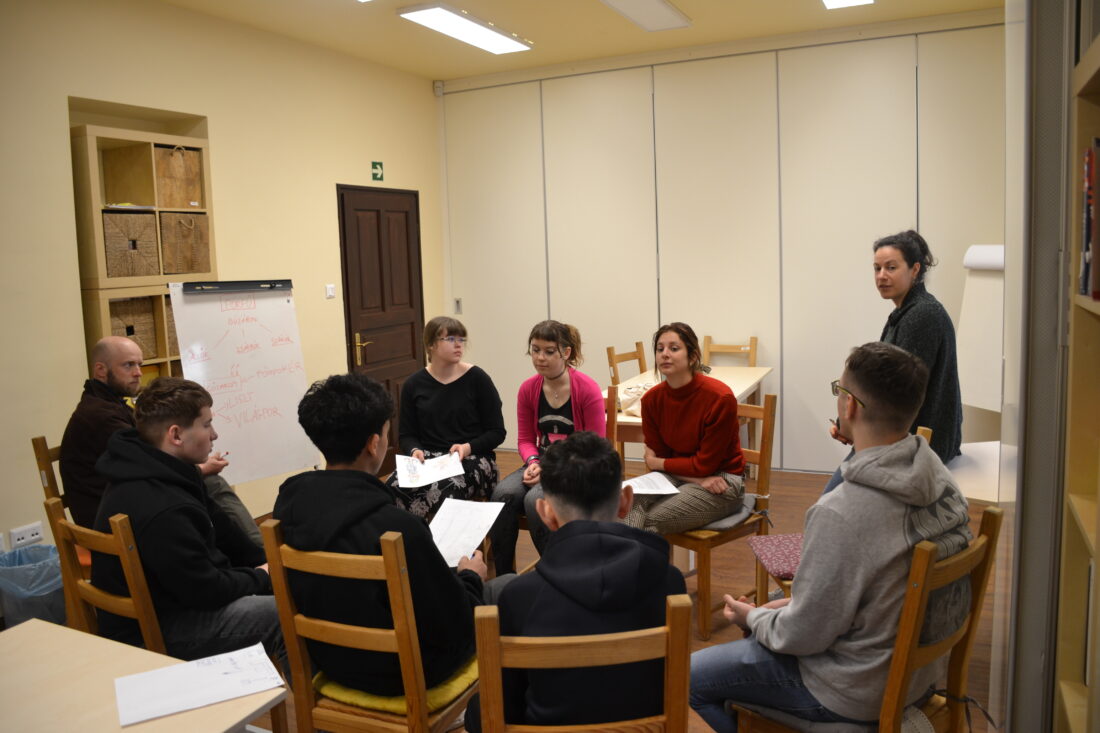
“During this session, I conducted the drama lesson with the P3 group as well, which I had tested with the other group last time. The session begins with a narration that introduces the players to the enclosed, unique world of Porfű. They get to know the people of the ‘buzárs,’ who build their civilization on wheat and a special invention, the steam mill. The mill produces not only food but also a mysterious substance called ‘world-dust’ (világpor), which satisfies almost all their needs—except for healing, which is becoming an increasing problem for them. Following this, participants actively shape the details of the world in small groups:
-
they create the appearance and culture of the buzárs,
-
they design the settlement and the steam mill,
-
they devise ways to use the world-dust,
-
they create their own language and forms of communication,
-
they portray holidays and traditions,
-
they create folk dances and an anthem,
-
they define the characteristics of the disease afflicting the buzárs.
The goal of the drama lesson is for participants to:
-
actively create and think together,
-
experience the responsibility of decision-making,
-
reflect on the relationship between power, technology, environment, and community,
-
recognize that in complex situations, there is no clearly ‘good’ decision.
With the P1 group, I started the drama lesson with a short attunement: sitting in a circle, everyone could share how they were feeling that day. This helped the group members arrive, tune into one another, and establish a safe, attentive atmosphere. As a warmup, we played the ‘Fruit Basket’ game, which quickly energized the mood. Students had to make statements about themselves that could be true for others as well, thus putting the group in motion while facilitating informal learning about each other. This was followed by the ‘Gate’ game, where the focus shifted to non-verbal communication: the returning player had to sense the ‘exit’ purely through gazes. This exercise particularly strengthened attention and mutual attunement. The ‘Lovers’ game also relied on eye contact but in a more complex situation: two designated participants had to find each other within the group. The others were present as active observers and participated by voting, which gave an exciting dynamism to the task. The ‘Rubber Man’ exercise took place in pairs and served to develop trust as well as physical and emotional attunement to one another. Following this, we performed mirror games, first in pairs, then in increasingly larger groups. The goal was for the leader and follower roles to switch continuously so that, from the outside, it was not obvious who was directing. This task was particularly good for developing cooperation, sensitive reaction, and finding a common rhythm. During the ‘Secret Conductor’ game, a player had to figure out who was directing the group’s movement. This exercise strengthened observation skills and the detection of subtle signals. In the ‘Exaggeration Circle’ task, students worked creatively on intensifying certain movements and sounds, which simultaneously developed expressiveness and courage, though appropriately dosing the intensity proved to be a challenge. In the second half of the session, more energetic games followed, such as ‘The Bomb,’ which required attention and quick reactions, as well as a movement-based connection game where they had to interact with each other based on various instructions. These exercises lightened the mood and strengthened group cohesion. We closed the lesson with a calmer, wind-down part: participants massaged each other’s shoulders in pairs. This helped in releasing tension and quieting down the experiences of the lesson.” – Hanga Martos, develpmental teacher
“With the P1 group, we continued robot programming today. First, we got acquainted with the use of the color sensor. By using the three sensors—distance, pressure, and color—our robot is capable of sensing almost all objects in its environment, including those at the bottom of the sea, allowing it to move autonomously. To successfully complete our mission, we must use the robot’s lifting arm. After learning the programming for the arm-operating motor, our robot is now not only able to move but is also capable of lifting and moving various elements. The P3 group finished designing the new units for the Martian Camp Elysium. The next task is to build these units—buildings. We are producing the designed buildings and tools using 3D printers found and repaired at the base, and after assembly, we will put them into operation. While the components of the buildings are being prepared, we are not idle. The robots we brought with us or found in the camp can provide great help in performing our tasks. The team became acquainted with the construction and basic programming of the robots. With this, we have taken the first step toward the complete reconstruction of Camp Elysium.” – Péter Schlepp, developmental teacher
Snapshots of the programs can be viewed in the Gallery .