

Our Mission Has Reached Its End
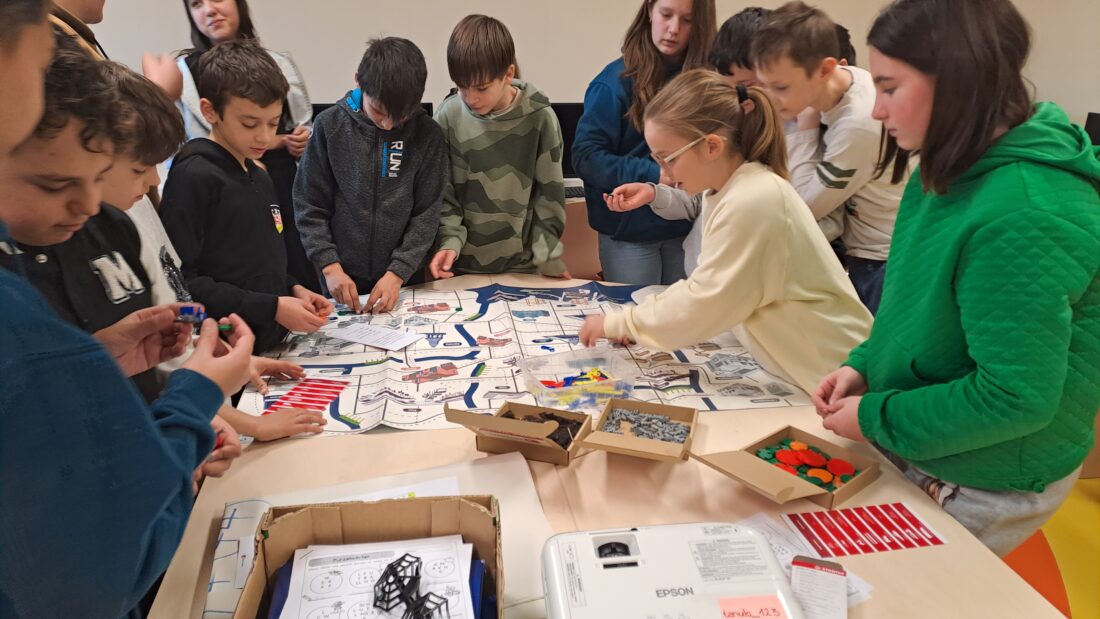
“With the members of the Mohács Group 3, we completed the Maker’s Red Box ‘Global Warning – Climate Expedition Around the Earth’ mission. The team’s task was to examine the consequences of global warming in various regions of the Earth and to learn about local best practices.
Before starting our virtual journey, we discussed exactly what global warming means, what its primary causes are, and what direct and indirect effects it has on our lives. We got to know our itinerary and the ship – the research vessel L.E.A.F. – on which we would spend the following months. We made a list of the equipment we would need. Naturally, personal items were not left off the list either.
In the next step, everyone designed their own cabin. For this, we used the Inkscape vector graphics editor program. The completed cabin designs were physically produced using a laser cutter.
We knew that a key element of the mission’s success was the division of labor. Therefore, everyone chose a field for which they were responsible. These roles and areas were as follows: policymaker, artist, influencer, researcher, entrepreneur, and inventor.
After everyone received their personal Ship’s Log, in which we could record our experiences and impressions during the journey, we boarded the research vessel and set off toward our first destination.
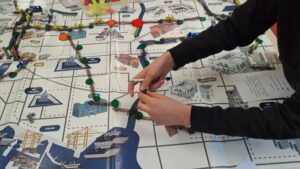
Our first stop was Chennai, India’s fourth-largest city. Here, we learned about the challenges global warming poses to a coastal city. Our main task was to study Chennai’s transportation-related problems and develop a sustainable urban transport model. To model the task, we designed transportation vehicles in Inkscape and printed them with a 3D printer. Alongside the main task, we made time to conduct ‘real or fake news?’ research regarding news related to the region.
After completing our tasks in India, we continued toward Palau. After departure, we received news that a volcano was about to erupt near our route. We decided to take a detour and examine the impact of a volcanic eruption on global warming. We made preparations to perform various measurements on-site. We refreshed our microcontroller – micro:bit – programming skills and assembled our instruments suitable for measuring light, sound, and CO2, as well as signaling earthquakes. We arrived in time to safely place the instruments and, after sailing to a safe distance before the eruption, we collected data using the micro:bit’s radio communication.
Approaching Palau, we received a welcome video from Palauan children, through which we learned about the diverse yet fragile nature of the archipelago. Upon arrival, we also had to sign the Palau Pledge, by which everyone entering the island commits to protecting and preserving the environment.
The main sources of income for Palau’s residents are fishing and tourism. Our main task on the island was to examine how the sea-level rise, rising water temperatures, and ocean acidification caused by global warming affect marine life, especially corals. Through our own investigations and experiments, it was proven that the warming and acidification of seawater destroy corals and thus the coral reefs that protect the coastlines and provide habitat for hundreds of marine animals. In Palau, we installed and programmed water-level monitoring stations and helped revive the island’s coral reefs with 3D-designed coral nurseries and artificial islands.
Filled with experiences and sunlight, we continued our journey. Our destination was the realm of eternal ice, the permafrost. Permafrost is the combination of the ice forming the substrate and all the material frozen within it. Thus, it contains countless tiny creatures preserved in ice over the past hundreds of thousands of years, mainly microbes and organic matter forming a dangerous mixture with microbes, viruses, and bacteria, which are the frozen decomposition products of dead animals and plants. This organic matter contains large amounts of CO2; however, due to the freezing, it cannot decompose completely. As a result of global warming, the permafrost begins to melt, causing the organic matter trapped in the frozen substrate to start decomposing, releasing vast amounts of greenhouse methane.
The final stop of our journey was South America, the mouth of the Orinoco River. This area is known, among other things, for its mangrove forests and swamps. Mangrove swamp forests are special salt-tolerant species that have adapted to the unique living conditions of the tidal zone. They live in tropical and subtropical areas, usually along sea and ocean coasts, and in so-called brackish waters at the confluence of river estuaries. Similar to coral reefs, swamp forests protect the coastline and provide living space for hundreds of fish and bird species. Mangrove swamp forests play an important role in the fight against climate change, as one hectare of mangrove forest has ten times the carbon sequestration capacity of terrestrial forests of the same size. At this station, we installed and programmed sensors to measure the salinity of the waters and examined the impact of energy crop and palm oil production—characteristic of the area—on global warming.
We have reached the end of our expedition and set off for home. We have completed a long but meaningful period. During the journey, we saw that some geographical areas are more affected by climate change, while others are more protected. As greenhouse gases increasingly warm the atmosphere, powerful changes are occurring in all three climate zones, but smaller, distinct climatic areas within the zones behave differently because their sensitivity is quite varied.
We learned what climate change means and how it affects our lives. We have gained knowledge and skills that help us consciously act against climate change in our immediate environment.” – Péter Schlepp, educator
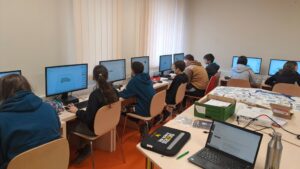
“What I’m taking with me is that corals can ‘cook’ due to the heat.” – Hanna Katona
“I learned to work with micro:bits and learned a lot about the greenhouse effect as well. I liked the cabin design best.” – Denissza Szász-Nica
“I really liked the whole expedition; my favorite place was Palau.” – Áron Krepp
“I participated in an exciting expedition; I liked Palau very much because I love corals.” – Levente Hunyadi
“I didn’t know that you have to take an oath in Palau; it was interesting to hear about this.” – Szilárd Kovács
“What I learned from this is how to take care of the environment. I liked the micro:bit the best; I’m glad I could participate in this project.” – Viktorina Krämer
“We learned how to program the micro:bit, performed various experiments, and traveled to several places. Everyone was given a role and had to work accordingly; sometimes we had to do research on the internet.” – Lili Fölker
“This adventure was long but very good. We had several stops during the journey, about which we learned many new things. For example, that Palau is a sponge city.” – Hanna Magos
“Chennai was interesting, especially because of the tuk-tuks.” – Emese Ráczga
“I liked the micro:bit very much; the expedition was full of exciting places.” – Olivér Csibor
“We learned a lot about Chennai; its technology is very underdeveloped.” – Szabolcs Lipták